Email: arthurcomichero@gmail.com
AUGMENT ALLIANCE HEROES
IMPALER — THE BALLBUSTING DEVICES — PART 1
By Arthur Comic
THE ASSEMBLY LINE
Three levels beneath Doc’s headquarters, the machinery never stopped.
The new production chamber had once been a freight depot beneath Grand Island City’s abandoned industrial corridor. Doc had transformed it into something closer to an underground weapons factory.
Hydraulic presses slammed down in perfect rhythm.
Robotic arms carried black metal cylinders from one station to the next. Carbon-steel shafts were inserted into reinforced launch housings. Small red indicator lights blinked awake as internal processors ran diagnostic sequences.
At the end of each line, the most important component was attached.
A circular mechanical head.
Eight narrow articulated arms surrounded its central collar. Each arm ended in a reinforced gripping point engineered to unfold, surround a target, and lock into place.
One weapon completed assembly.
Then another.
Then another.
Hundreds already rested in steel racks along the walls.
A technician watched another device pass its diagnostic.
UNIT 0187
DEPLOYMENT SYSTEM: READY
TARGET ACQUISITION: READY
ANCHOR MECHANISM: READY
COMPRESSION SYSTEM: READY
A final line appeared.
IMPALEMENT PROTOCOL: READY
The technician swallowed.
Doc stood behind him.
“Run it.”
The technician pressed the activation control.
Across the testing chamber stood an armored synthetic replica of an Augment hero. At its waist was a reinforced mock codpiece—the latex covering surrounding the technology inside each of the Augment heroes testicles that helped stabilize an Augment’s enhanced abilities.
The weapon fired.
THOOM.
Its shaft shot across the chamber.
Halfway toward the target, the mechanical head unfolded.
One stage.
Two.
Three.
The narrow arms expanded outward until the weapon resembled a metallic flower.
Then they slammed around the simulate codpiece.
CLANG.
The arms locked.
The synthetic target tried to pull away.
The weapon held.
A monitor displayed simulated Augment output.
100%.
The device tightened.
84%.
Another mechanical adjustment.
68%.
The regulator began flashing warning signals.
51%.
Doc stepped closer to the glass.
The technicians watched him instead of the experiment.
Everyone working inside the facility had learned that silence was safest when Doc was thinking.
The output dropped again.
39%.
Doc finally spoke.
“Stop.”
The mechanism froze.
One technician looked relieved.
Doc wasn’t.
“Why did it take eleven seconds?”
The room became silent.
“Sir?”
“Eleven seconds from initial contact to forty-percent suppression.”
The technician checked the data.
“Ten-point-eight.”
Doc slowly turned toward him.
“That is eleven.”
“Yes, sir.”
“An Augment hero can demolish half this room in eleven seconds.”
Doc looked back toward the captured training dummy.
“A weapon does not become useful simply because it eventually works.”
He tapped the glass.
“It becomes useful when the victim understands what is happening only after it is already too late. Those balls need to get busted and gripped faster!”
The technicians exchanged nervous looks.
Doc walked toward the production floor.
“Increase deployment speed by fifteen percent.”
“That will put additional stress on the articulation motors.”
“Then replace the motors.”
“It could increase production cost.”
Doc stopped.
Hundreds of unfinished weapons stretched into the darkness behind him.
“You’re still thinking like an engineer.”
He turned.
“I am manufacturing fear.”
Above the production floor, an enormous monitor illuminated.
A rotating image of the weapon appeared.
Across the screen:
IMPALEMENT SYSTEM
Below it:
FIELD NAME: IMPALER
Doc smiled.
“Now,” he said, “we need a hero.”
Doc’s private laboratory occupied the highest underground level of the complex.
There were no assembly lines here.
No workers.
No noise.
Only glass displays, holographic schematics and equipment recovered from years of battles with Augment heroes.
Fragments of damaged armor.
Mounted remnants of codpieces, nipple coverings, glute casings - Doc had a fetish for his nemesis’s.
Destroyed communication units.
Pieces of energy regulators.
A ripped latex red suit sat beneath one light.
Razor.
Doc stopped beside it.
Razor’s captivity had changed everything.
The Syndicate Games had given Doc something more valuable than victory: data.
Millions of telemetry points had been collected while Razor fought, resisted, exhausted himself and pushed his damaged Augment system beyond recommended limits.
Doc now understood how much punishment the regulators inside their testicles could tolerate.
How quickly it compensated.
Where its shielding was strongest.
And where its defensive nano technology architecture became vulnerable when the hero demanded maximum output.
The Impaler had been designed around those discoveries.
A hologram appeared.
The weapon separated into individual components.
LAUNCH BODY.
EXTENSION SHAFT.
ARTICULATED ANCHORS.
REGULATOR SCANNER.
COUNTER-PULSE GENERATOR.
COMPRESSION COLLAR.
Doc expanded the final section.
The central collar contained sensors capable of reading fluctuations coming from an Augment regulator.
The weapon wasn’t simply mechanical.
It adapted.
If the hero increased power, the Impaler increased pressure against the regulator’s biotech shell inside the testicles.
If the hero tried to release an energy pulse, the weapon redirected part of that surge back into its own locking system.
If the hero remained still, the device maintained suppression without destroying the equipment.
That distinction mattered.
Doc did not want dead heroes.
Dead heroes couldn’t provide data.
And destroyed Augment systems couldn’t be reverse-engineered.
He wanted control.
He also wanted to drain and torture prime muscle heroes in bondage. He had a kink.
The door opened.
Krieg entered.
The massive villain looked through the glass wall toward the production floor.
“So that’s it?”
Doc didn’t turn.
“The first production series.”
Krieg watched another rack being filled.
“How many?”
“Four hundred and eighty by morning.”
Krieg laughed.
“You’re building an army.”
“No.”
Doc enlarged a world map.
Dozens of cities appeared.
London.
Berlin.
Rio.
Toronto.
Tokyo.
Mexico City.
Barcelona.
Melbourne.
Cape Town.
Grand Island City.
“I’m giving Syndicate armies something they have never possessed.”
The map filled with images of Augment heroes.
“A standardized weapon.”
Krieg approached the hologram.
“Every Augment is different.”
“Their abilities are different.”
Doc touched the image of an Augment regulator.
“This isn’t.”
Krieg understood.
“The housing.”
“The architecture varies slightly by generation, but the principle remains consistent.”
Doc rotated the Impaler beside it.
“We don’t need to defeat every power.”
The claws unfolded around the holographic regulator.
“We defeat what regulates the power.”
The weapon closed.
Krieg grinned.
“What are you calling it?”
“Impaler.”
“I like it.”
“The buyers have another name.”
Doc looked at him.
“The busting device.”
Krieg laughed.
“Subtle.”
“Villains don’t purchase subtlety.”
Doc shut down the hologram.
“But before anyone receives one, the Impaler requires something simulations cannot provide.”
“A live test.”
Doc nodded.
“On an active Augment.”
Krieg smiled.
“Then let’s go hunting.”
Doc shook his head.
“Hunting is inefficient.”
He walked toward the command room doors.
“We already know who we’re taking.”
The villain council gathered that night.
Unlike the theatrical arena used during the Syndicate Games, Doc’s secret floor in his lower level headquarters was functional and severe.
Black walls.
Steel floors.
No banners.
No monuments.
Only information.
At the center of the command room, Grand Island City appeared as a three-dimensional hologram.
Red points marked known Alliance patrol zones.
Yellow lines showed transportation routes.
White circles represented probable locations of concealed Alliance sensors.
Krieg stood beside two Apex Dominion commanders.
Representatives from Black Meridian and the Iron Circle watched remotely.
Doc entered.
“The first Impaler field trial will take place within seventy-two hours.”
One of the commanders leaned forward.
“Who?”
Six images appeared.
SLATE.
RAZOR.
VANGUARD.
FLARE.
VERN.
TECTONIC.
The commander pointed immediately.
“Razor.”
Doc deleted Razor from the display.
“No.”
Krieg raised an eyebrow.
“You spent months breaking him down.”
“Which means the Alliance spent weeks rebuilding him.”
Doc enlarged Razor’s medical and tactical reconstruction estimates.
“Marcus knows we analyzed Razor. Vand Technologies will have reinforced every vulnerability they discovered after his rescue.”
Another villain pointed toward Slate.
“The leader.”
“Too strategically important. If Slate disappears, every Alliance hero mobilizes immediately.”
Vanguard appeared next.
“Vanguard?”
“Too destructive.”
Flare.
“Unpredictable in confined spaces.”
Tectonic.
“Difficult extraction profile.”
Finally only one image remained.
Green latex.
Black gloves.
Black belt.
Young face.
Huge dangling codpiece.
VERN.
Krieg stared at the image.
“The rookie?”
Doc enlarged Vern’s profile.
“Not because he’s weak.”
Footage began playing.
Vern during the Razor extraction.
Vern disabling surveillance cameras.
Vern scrambling a villain communications node.
Vern interrupting targeting systems long enough for Vanguard to breach a containment corridor.
Another clip.
Vern overriding an automated security door.
Another.
Vern redirecting a tracking beacon.
Doc paused the footage.
“He attacks technology.”
One commander finally understood.
“You want the hardest possible electronics test.”
“Exactly.”
Doc brought up an Impaler schematic.
“The device’s greatest theoretical weakness is electronic disruption during initial deployment.”
Vern’s image appeared beside it.
“If the Impaler functions while Vern is actively attempting to disable it, then it functions against nearly every conventional countermeasure currently used by the Alliance.”
Krieg looked impressed.
“So Vern isn’t just the test subject.”
“He’s certification.”
Doc zoomed in on the young hero.
The green suit reflected city lights as Vern moved between rooftops.
“He also has another advantage.”
“What?”
“He believes he understands my systems.”
Doc replayed the rescue footage.
Vern had beaten Doc’s surveillance.
Vern had interrupted his communications.
Vern had helped find Razor.
“He participated in the rescue.”
The room went quiet.
Doc’s expression hardened.
“Which means he thinks he’s already beaten me once.”
Krieg smiled.
“And you want him confident.”
“I want him curious.”
Doc replaced the hero roster with a map.
A warehouse district appeared near the river.
“We won’t chase Vern.”
Three red transmission points illuminated.
“We will send him an invitation.”
Marcus noticed the first signal at 2:17 the following morning.
It lasted thirteen seconds.
Too short for full triangulation.
Long enough for the Alliance computers to recognize the encryption.
Marcus sat upright at the operations desk.
Across Vand Technologies’ upper command floor, the Grand Island City skyline glowed beyond enormous windows.
He replayed the signal.
Static.
Encrypted telemetry.
Then a familiar sequence.
Marcus’s expression changed.
He had seen that frequency before.
During Razor’s captivity.
“Vern.”
The young hero appeared moments later on the communications display.
He was already in his green anatomically correct latex uniform.
“What’s up?”
Marcus transmitted the recording.
Vern listened.
His relaxed expression disappeared.
“That’s Doc.”
“Maybe.”
“No. That’s his carrier architecture.”
“You’re sure?”
“I spent six hours pulling it apart during the rescue.”
Marcus enlarged the signal map.
“It appeared here.”
A point flashed near the industrial waterfront.
“Then disappeared.”
Vern leaned closer.
“You want me to trace it.”
“I want you to tell me what it is.”
“Same thing.”
“Not remotely.”
Vern smiled.
Marcus didn’t.
“Razor nearly died because we underestimated Doc.”
The smile vanished.
“I know.”
“Then don’t make me repeat myself.”
Vern nodded.
“Remote diagnostics only.”
“Good.”
The transmission ended.
Marcus stared at the map.
Something bothered him.
Doc wasn’t careless.
If the signal was real, why had they detected it?
Forty-seven minutes later, it returned.
Different location.
Same encryption family.
This time Vern was already analyzing it.
“It’s moving.”
Marcus stood.
“What?”
“The transmission source changed.”
“Mobile platform?”
“No.”
Vern expanded the data.
“It’s being rebroadcast.”
A third signal appeared.
Vern froze.
This one contained something different.
A damaged telemetry signature.
Red.
Marcus recognized it.
“Razor.”
Vern shook his head.
“Not Razor himself. Old Razor telemetry.”
“From the arena?”
“Looks like it.”
Marcus swore quietly.
Doc still had data.
Possibly servers.
Possibly entire archives from the Syndicate Games.
If the Alliance could recover them, they could learn exactly what had been stolen.
Vern looked toward Marcus.
“I can trace this.”
Marcus hesitated.
“You’re not going alone.”
“I’m not going inside anywhere. I just need proximity.”
Marcus considered it.
“Vanguard shadows you.”
“He’ll light up every sensor in the district.”
“Then Flare.”
“Same problem.”
Vern tapped the screen.
“Doc expects muscle.”
Marcus stared at him.
“And what does he expect you to do?”
Vern grinned.
“Exactly what I’m about to do.”
Marcus didn’t like that answer.
But Vern was already moving.
Across the city, Doc watched everything.
A stolen observation camera had captured Vern leaving Alliance airspace.
Doc checked the clock.
Exactly according to projection.
Krieg stood behind him.
“That’s your trap?”
“No.”
Doc watched Vern leap between buildings.
“The trap begins when he realizes there is a trap.”
Rain began shortly after midnight.
Vern moved alone across Grand Island City’s industrial rooftops.
Green armor flashed beneath occasional security lights.
His visor displayed the signal ahead.
2.8 mph.
He stopped.
Something was wrong.
Too easy.
He accessed his communicator.
“Marcus.”
“Here.”
“Signal stopped moving.”
“Location?”
“Old Vandwell freight district.”
Marcus immediately answered.
“Turn around.”
Vern looked across the rooftops.
The abandoned district stretched toward the river.
Old factories.
Loading yards.
Rail tunnels.
Darkness.
“You know something?”
“I know Doc isn’t broadcasting Razor telemetry from an abandoned building because he forgot to encrypt it.”
Vern smirked.
“Fair.”
“Come home.”
Then Vern noticed something.
A power spike.
He crouched.
“Wait.”
“Vern.”
“There are active systems below me.”
“How many?”
Vern scanned.
His expression changed.
“A lot.”
“What kind?”
“I can’t tell.”
He transmitted a low-level interference pulse into the structure.
Nothing.
Another.
Still nothing.
That was unusual.
Most conventional electronics flickered immediately.
“These systems are shielded.”
Marcus’s voice sharpened.
“Leave.”
Vern stood.
Then every light in the district turned on.
Not gradually.
Instantly.
Hundreds of white industrial lamps illuminated the streets.
Vern froze.
Marcus shouted through the communicator.
“VERN!”
The lights shut off again.
Darkness.
Vern fired a stronger disruption pulse.
Somewhere beneath the pavement, a machine activated.
Then another.
Then twenty more.
Vern backed away.
“Yeah.”
He turned.
“Definitely leaving.”
The rooftop exploded behind him.
Not from a bomb.
A metal shaft punched through the concrete.
Vern jumped.
The weapon missed him by inches.
Its head unfolded in midair.
Eight mechanical arms spread apart.
Vern landed twenty feet away.
“What the hell is that?”
The weapon retracted into the darkness.
Marcus had seen it through Vern’s camera.
“I don’t know.”
Another wall opened.
A second device emerged.
Vern raised both hands.
His Augment pulsed.
A disruption wave slammed into it.
The weapon flickered.
Stopped.
Vern smiled.
“Got you.”
Then its red lights switched back on.
His smile disappeared.
“Oh.”
The weapon fired.
Vern dove.
The shaft tore through a ventilation unit behind him.
A third device deployed.
Then a fourth.
Vern ran.
His boots struck wet metal as he crossed a narrow rooftop bridge.
“Marcus, somebody designed these specifically against electronic interference.”
“I’ve already dispatched Vanguard and Flare.”
“How far?”
“Eight minutes.”
Vern looked behind him.
Three Impalers were tracking him.
“I don’t think I have eight minutes.”
He jumped.
In Doc’s command room, technicians watched the pursuit.
VERN INTERFERENCE OUTPUT: 71%.
IMPALEMENT SYSTEM RESPONSE: STABLE.
Doc leaned toward the screen.
“Revision seven.”
The chief engineer nodded.
“Performing within specification.”
Krieg watched Vern dodge another strike.
“He’s good.”
Doc smiled faintly.
“That is why I chose him.”
THE TRAP
Vern crashed through the window of an abandoned processing plant.
Glass scattered across the floor.
He rolled.
Stood.
Immediately scanned the room.
Nothing.
No signal.
No movement.
He breathed.
“Marcus?”
Static.
“Marcus?”
Nothing.
Vern looked at his communicator.
CONNECTION LOST.
He tried another frequency.
Blocked.
“Okay.”
He slowly turned.
“This is bad.”
A light activated.
One.
Then another.
Then hundreds.
Vern stood in the center of a circular chamber.
White walls.
Reinforced floor.
Observation windows high above him.
His expression hardened.
He had walked directly into it.
A voice filled the room.
“Hello, Vern.”
Vern looked upward.
“Doc.”
Doc appeared behind the observation glass.
Hands clasped behind his back.
“You’ve become difficult to surprise.”
“Apparently not difficult enough.”
“I appreciate self-awareness.”
Vern scanned the walls.
“I liked your old place better.”
“You destroyed parts of my old place.”
“Yeah.”
Vern looked around.
“That was the part I liked.”
Doc smiled.
Panels opened around the chamber.
Six Impalers emerged.
Vern’s confidence faltered.
Doc watched carefully.
“You recognize them?”
“Ugly retractable sticks?”
“We can workshop the marketing.”
Vern raised his hands.
Energy built around his Augment network.
Doc’s monitors reacted.
“Here comes the interesting part.”
Vern released everything.
A powerful disruption wave blasted outward.
Lights died.
Observation monitors flickered.
Three Impalers dropped offline.
Vern ran.
A fourth weapon rebooted.
Too fast.
It fired.
Vern twisted.
The mechanical head missed its intended lock but caught against the side of his codpiece. His right nut.
He ripped it free before the arms closed.
Doc stared at the telemetry.
“Excellent.”
Vern threw the weapon across the room.
“You’re welcome.”
Then another fired.
Vern disrupted it.
Another.
He disrupted that too.
Sweat appeared on his forehead.
Each pulse required more energy.
Doc watched his output.
VERN AUGMENT OUTPUT: 82%.
Then:
76%.
Vern saw it too.
“You’re making me drain myself.”
Doc’s voice came through the chamber.
“Now you understand.”
Another Impaler launched.
Vern jumped.
Another fired from overhead.
He redirected midair.
The weapon missed.
Vern landed.
The floor panel beneath him opened.
His eyes widened.
THOOM.
The shaft shot upward.
The articulated head expanded.
Vern reacted with another disruption pulse.
For half a second the device froze.
Half a second wasn’t enough.
The system rebooted.
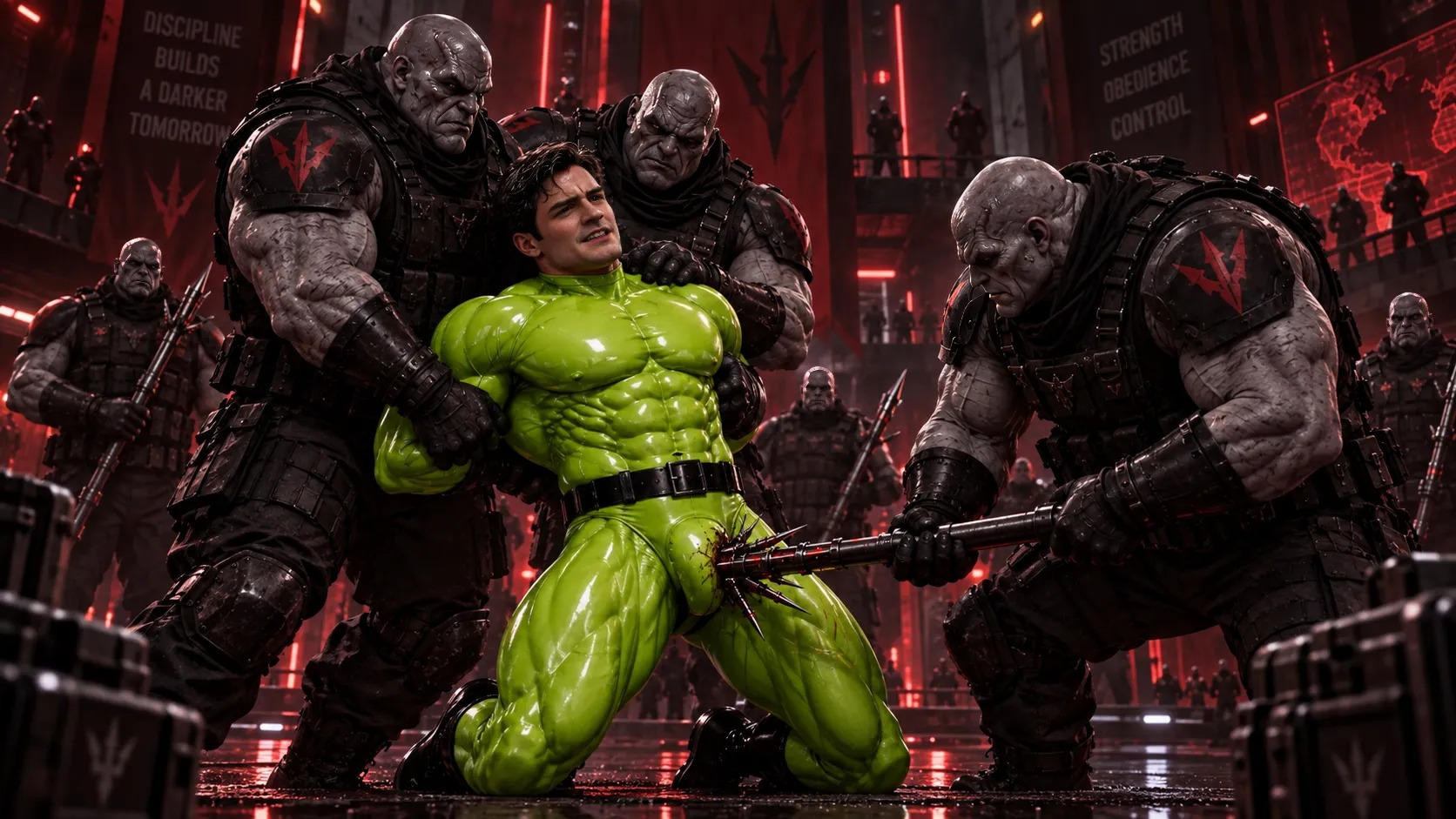
The arms snapped into position around the base of the balls on his green latex codpiece, his plump low danglers.
CLANG.
Vern gasped.
The shaft locked.
He grabbed it with both hands.
“What—”
The device tightened against the nuts.
His Augment output dropped.
69%.
Vern pulled.
The Impaler pulled back.
61%.
He fired an electronic pulse directly into the mechanism.
The red lights flickered.
Doc leaned toward the glass.
Everyone in the command room stopped breathing.
The weapon remained locked.
54%.
The chief engineer whispered:
“It held.”
Doc smiled.
For the first time that night.
“Yes.”
Below them, Vern planted both boots and pulled against the shaft.
“GET THIS THING OFF ME!”
Doc watched the telemetry.
The production test had officially begun.
Vern refused to stop fighting.
That was precisely what Doc wanted.
He drove another pulse through the Impaler.
Its processor reset.
The locking arms loosened two millimeters.
Vern felt it.
His eyes widened.
He pushed harder.
Doc noticed.
“Interesting.”
SYSTEM LOCK: 91%.
89%.
86%.
The engineer looked nervous.
“He’s degrading the clamp.”
Doc didn’t react.
“Let him.”
Vern concentrated.
The Impaler shook on his balls.
His green latex suit reflected the chamber’s harsh white lights as energy surged through his Augment.
VERN OUTPUT: 48%.
But the lock weakened.
82%.
79%.
Vern grinned.
“You built a machine.”
He looked toward Doc.
“I break machines.”
Then the second Impaler fired.
Vern heard it too late.
It struck the first device’s reinforced anchor section and locked onto it, creating a cross-braced restraint. Around his cock.
Vern’s expression changed.
Doc spoke calmly.
“You break individual systems.”
A third panel opened.
“The Impaler was designed as a network.”
The second device synchronized.
Then the first.
Their processors began sharing load.
Vern sent another disruption pulse.
Instead of overwhelming one system, the signal divided across both.
His advantage disappeared.
LOCK STABILITY: 97%.
Vern pulled.
Nothing.
The third Impaler emerged but did not fire.
It simply tracked him.
A warning.
Doc wanted Vern to see it.
“You’re testing me.”
“Correct.”
“Why?”
Doc walked closer to the observation window.
“Because Razor gave us information.”
Vern’s face hardened.
Doc continued.
“More than he knows.”
Vern pulled again.
“Razor didn’t give you anything.”
“No. We took it.”
Doc activated the wall behind him.
For the first time, Vern could see beyond the observation chamber.
His eyes widened.
Rows.
Hundreds of black devices.
Identical to the one holding him.
Assembly racks stretched deep into the facility.
Vern stopped struggling.
Doc watched the realization settle over him.
“This isn’t one weapon.”
Vern stared.
Doc nodded.
“No.”
A world map appeared on the glass.
Crates illuminated beside dozens of destination markers.
Berlin.
London.
Rio.
Toronto.
Tokyo.
Mexico City.
Cape Town.
Melbourne.
Barcelona.
Lagos.
Grand Island City.
Doc stepped forward.
“This is the first standardized anti-Augment capture system.”
Vern looked back at the weapons.
“How many?”
“Enough.”
“You think villains are going to beat the Alliance with gadgets?”
“No.”
Doc’s voice remained almost conversational.
“I think villains have spent years fighting Augments incorrectly.”
Images appeared around Vern.
Heroes overpowering brutes.
Heroes escaping restraints.
Heroes surviving energy weapons.
Heroes destroying armored vehicles.
Heroes with their tight muscle bodies the darlings of their cities.
“Everyone keeps trying to overpower you.”
Doc touched a control.
The Impalers tightened one increment.
Vern’s Augment warning flashed.
43%.
Doc continued.
“I don’t need to overpower an Augment.”
Another adjustment.
39%.
“I need to control the technology that allows him to remain one.”
Vern looked toward the observation window.
His fear was visible now.
Not panic.
Understanding.
Doc preferred understanding.
Vern activated his communicator again.
Still blocked.
Doc glanced at the clock.
“Vanguard and Flare are approximately five minutes away.”
Vern looked up sharply.
Doc smiled.
“You thought I didn’t know?”
Alarms activated elsewhere in the facility.
Not warnings.
Preparation.
Heavy doors sealed.
Automated defenses powered up.
Krieg entered the observation chamber.
“So we kill the rescuers?”
Doc shook his head.
“No.”
He looked down at Vern.
“The field trial is complete.”
A technician approached.
“Certification status?”
Doc looked at the telemetry.
Vern had disrupted the device.
Dodged it.
Damaged one.
Nearly escaped the first lock.
Exactly the challenges Doc needed.
And the revised network had held.
Doc answered.
“Approved.”
Across the factory floor, screens changed simultaneously.
IMPALEMENT SYSTEM — FIELD CERTIFIED
Then another message:
BEGIN MASS DISTRIBUTION
Production machinery accelerated.
Assembly lines moved faster.
Crates began sealing.
Robotic transports carried the first shipments toward underground loading tunnels.
Vern stared through the glass.
“Doc!”
Doc turned away.
“DOC!”
He stopped at the door.
Vern pulled against the restraints.
“You won’t get these out of the city.”
Doc looked over his shoulder.
“Some already left yesterday.”
Vern froze.
Doc had never needed this test to decide whether production would begin.
He needed it to decide whether production would expand. Grand Island City would be the global capital of villain’s manufacturers. And his bank account would be loaded.
The laboratory doors closed.
Krieg followed him.
“What happens to Vern?”
Doc glanced toward another monitor.
Vanguard and Flare were approaching the perimeter quickly.
He smiled.
“Now?”
He pressed one control.
Inside the chamber, the remaining four Impalers activated.
Vern looked around as red lights illuminated one after another.
Doc watched through the monitor.
“Now we discover how long a hero can keep fighting after the Impaler has him.”
The first additional targeting system locked onto Vern.
TARGET CONFIRMED.
The second followed.
TARGET CONFIRMED.
Vern clenched his fists.
His remaining Augment energy began building.
Outside, somewhere beyond the underground walls, an explosion shook the facility.
Vanguard had arrived.
Doc looked toward the ceiling.
Exactly on schedule.
He turned back toward Vern’s monitor.
“Begin phase two.”
The impalers gripped into every source of tissue in Vern’s testicles. It made him erect and hard. One of the impalers began to thrust inside the base of his cock. The thin needles crunching the testicles. It was beyond agony.